16 January 2007

The Science of Procrastination

So, a new year has just started not too long ago. Made your New Year Resolutions? If yes, then here's some scientific excuse for yourself not to follow them.

According to this article from ScienceDaily (which I arrived via Slashdot), it concluded that

  • Most people's New Year's resolutions are doomed to failure

  • Most self-help books have it completely wrong when they say perfectionism is at the root of procrastination, and

  • Procrastination can be explained by a single mathematical equation


Heh heh, this is quite interesting. As the professor explained, "Perfectionism is not the culprit. In fact, perfectionists actually procrastinate less, but they worry about it more." Well, does that mean that we should not aim for a too well-rounded resolution or goal when setting one?

Steel says motivational failures such as difficulty in sticking to diets and exercise regimes -- frequently the focus of New Year's resolutions -- are related to procrastination because impulsiveness is often at the root of the failure.


So a resolution or a goal should be one which is carefully thought out, not one that is made over dinner or during a conversation. I think the typical goal-setting plan should kick in here. To avoid procrastination in a plan, one has to set many mini-goals within a reasonable timeframe to motivate one to continuously achieve.

Interestingly, the article points out that

The good news is that willpower has an unusual capacity. "The old saying is true: 'Whether you believe you can or believe you can't, you're probably right'," Steel says. "And as you get better at self control, your expectancy about whether you can resist goes up and thus improves your ability to resist."


But what if a person doesn't believe in the existence of free will? Then there is no willpower to talk about, and if one is meant to procrastinate, one has to procrastinate. More motivation to find out if free will exist then? Oh well...

Procrastinate now without worry, for you have the backing of science!

12 January 2007

Nuclear Power in Question

In the 80s and 90s, nuclear (fission) power was greatly shunned by the public, with many advocacy groups called a complete ban of it. This was partly due to the proliferation of nuclear weapons as well as several disastrous nuclear accidents.

In recent years, nuclear power is back in the limelight, not as the object of criticism but as a possible alternative to the growing energy crisis. Considering that it is clean (no carbon emission) and its fuel not running out any time soon, it looks more and more promising as an alternative candidate with the rising price of oil and environmental concern with coal (for example, a coal-burning power plant releases radioactive products into the air, exposing people to radiation several times more than a fission power plant). Other promising alternatives like solar and nuclear fusion are still not practical.

However, not all is smooth for nuclear power. The journal Nature carried a recent news article (obtained via Slashdot) that demonstrated past methods in disposing nuclear waste is not as safe as previously thought.

Quoting from the article,

A fast-moving alpha particle knocks into hundreds of atoms in its path, scattering them like skittles. Worse still, the radioactive atom from which the particle comes is sent hurtling in the other direction by the recoil. Even though its path is even shorter than that of an alpha particle, the atom is much heavier, and can knock thousands of atoms out of place in the ceramic.

All this disrupts the crystalline structure of the ceramic matrix, jumbling it up and turning it into a glass. That can make the material swell and become a less secure trap. Farnan says that some zircons that have been heavily damaged in this way by radiation have been found to dissolve hundreds of times faster than undamaged ones. So if the ceramic gets wet, there could be trouble.


There are, of course, other concerns, such as how one can lower the chances of nuclear accidents like the Three Mile Island accident. And then of course there's always the controversy linked to nuclear weapons. I cannot, however, comment from a technical point of view, since my course on Nuclear and Particle Physics has only started, but I guess that even after that, my knowledge is still too insufficient.

09 January 2007

Free Will (Part III)

(This entry is the third part of my train of thoughts about free will. The previous two entries can be accessed here: Free Will (Part I) and Free Will (Part II).)

This is an absurdly overdue entry. But there is a reason for the delay - the concept of free will has burrowed into the depths of obscure philosophy, and each logical step has to be taken carefully and examined thoroughly, and often ending up in a terrible blur. Since the last post, I've read numerous articles and had several discussions, and I think it's time to pull some meat slices out from the murky soup.

In summary, the previous two entries talked about how free will cannot be possible if our physical laws are deterministic (classical mechanics) or random (quantum mechanics). Since then I explored the various underlying assumptions of this view and how they can be made to be otherwise. One possibility Yao has highlighted to me was that there is a concept that is not subjected to physical laws, which is, for a lack of a better word, "reason", or the connection between cause and effect.

By this I mean something like, for example, the presence of a mass will result in a force - (Newtonian) gravitation. The presence is the cause and the force is the effect. The connection is the ability to see that the presence of mass causes the force. If I apply a force on an object, the object will accelerate. In this case, force is the cause and acceleration is the effect. To be able to understand that this cause "causes" the effect, is what I mean here by "reason".

But what does "reason" has to do with free will? Well, nothing that I know of! Yes, "reason", as far as I can see, has nothing to do with free will. But all Yao is trying to raise is the argument that there may exist certain mental process that are not subjected to physical laws, and it is there that free will can exist.

The trouble with this concept is that, perhaps, it's just inventing something up to satisfy our opinion. That is, there is no meaning in objectifying the bridge between cause and effect, because there is simply none! It's somewhat like saying, there's an apple in a basket and I put in one more apple. So 1 + 1 = 2, and now I have two apples in the basket. And free will hides in that equal sign.

But if we assume that everything is subjected to physical laws, then how can free will exist? One notion I've heard/read more than once is that although the basic laws, the first principles, the underlying equations... they're all deterministic (or random), when you add them up, you'll get something extra. So the equation becomes 1 apple + 1 apple = 2 apples + 1 free will. Putting it another way, if we can make computers as complex as the brain, then it will have free will.

But does it? Does a sufficiently complex mind have free will? Or does it have the illusion of free will?

The sad thing is, we may not even find out, because mathematically that is impossible, thanks to mathematical genius Kurt Gödel. Quoting from this article which touches on his theories on logic,

Another implication is there is no algorithm, or recipe for computation, to determine when or if any given computer program will finish some calculation. The only way to find out is to set it computing and see what happens. Any way to find out would be tantamount to doing the calculation itself.


According to this, it means that when a certain complex mind, build up by basic blocks of deterministic calculations, is presented with two options, whether its choice is fixed or based on free will, there is no simple formula, or a shortcut, to find out. The only way is to run through the algorithm of making the choice, which is the mind making the choice itself.

Zooming out, we see more and more experiements "infringing" on free will. From the same article, an experiment on making random actions showed that

brain signals associated with these actions occurred half a second before the subject was conscious of deciding to make them.


Of course, this does not mean free will doesn't exist. As the article summarises,

the conscious brain was only playing catch-up to what the unconscious brain was already doing.


Which means we may not have control over the unconscious brain, there is still this glimmer of hope that we may have control over our conscious brain and hence our choices.

But that experiment was conducted decades ago. This more recent one has shown that, in an experiment involving fMRI,

the authors were able to successfully predict whether the study participants would decide to purchase each item.


Again, this doesn't mean that free will doesn't exist. What it has showed is that many other measureable factors play a part in decision-making. And these may even be undeterministic (i.e. free will).

But somehow, as science rumbles on, I'm beginning to feel that the arguments for free will wearing thin...

05 January 2007

Movie Review: Curse of the Golden Flower

It's not a movie I was dying to watch; it's not even one which I would consider watching. But since some friends have asked me to join in, I thought I might as well do so, since I haven't watched a movie some time, and I was pretty impressed by Zhang Yimou's Hero as well.

So how does Curse of the Golden Flower measure up? It's certainly not Heroic, but I do think it is better than Zhang's other film House of Flying Daggers. It has Zhang's trademark use of staggering visuals and colours in his scenes, but it also has (at least for his internationally successful movies) his trademark of a simple storyline spun into a confounding plot.

I'm not sure if that was deliberate... a choice of his... but I thought he could do better with a deeper or more meaningful story. This one is mainly about betrayal and assassination within the royal family, and once one strips off the confusing excesses, the plot is pretty straightforward. And this movie is a love story/soap opera, which isn't my genre of movies or stories.

As mentioned, Zhang's use of colours and breathtaking visuals are excellent, as usual, though this time most of the scenes take place indoors. The music, on the other hand, is rather crappy. There was consistent use of choir-like music (no words though, just singing of the tune) which seemed to be a blend of those Latin choir pieces that Hollywood likes so much nowadays and traditional Chinese orchestral music. I don't know what other people think, but I found it disappointing. In any case, I did not stay during the credits to listen to Jay Chou's song for the movie, so no comments on that.

Oh, if the music director did a bad job, the costume designer was even worse. Before watching the movie, I already heard complaints of scantily clad actresses in the movie (excluding those that are not supposed to look nice). And they certainly weren't exaggerating. Looking at the progression of Zhang's movies since Hero, I see a trend of females wearing less and less. I suppose in his next few movies we can expect ancient Chinese women prancing around in bikinis or nipple rings.

Lastly, the acting was disappointing. It had strong and experienced artistes: Chow Yun-Fat and Gong Li, but I didn't see any brilliance in them. Okay, Gong Li wasn't that bad, but I was far from impressed by Chow Yun-Fat. For some reason, I doubt he is suitable for that role. As for Jay Chou, I think for a newcomer he's fine. Not unexpectedly, he's not very capable of showing expression (he somehow seemed to be stuck eternally in his boh chup (nonchalant) look), but if he puts in more effort in his future movies, he'll turn out to be a decent actor. After all, given his huge fan base, most movie producers would like to have him in.

Before I end, I must say that I currently may not be in the most lenient mood to judge movies. Having finished, from renting VCDs, certain critically acclaimed movies like The Constant Gardener and The Pianist, it'd be hard for movies to look good in my eyes. Curse of the Golden Flower is decent, but it could've been better.

25 December 2006

Science of Santa

North Carolina State University has published a news release that argues the scientific viability of Santa Claus, backed by the university's professor of mechanical and aerospace engineering.

From the article, Santa and his elves have

advanced knowledge of electromagnetic waves, the space/time continuum, nanotechnology, genetic engineering and computer science easily trumps the know-how of contemporary scientists


and how they used scientifically fantastic innovations to carry out his duties.

Naturally, this post is written somewhat in a casual manner, ignoring the technological viability of some of methods used. It is pretty interesting to see imagination and science explain what appears to be impossible phenomena.

However, impressive explanations like

a sophisticated signal processing system filters the data, giving Santa clues on who wants what, where children live, and even who’s been bad or good


sounds pretty Nineteen Eighty-Four to me...

21 December 2006

Singapore's Stand on Antipersonnel Landmines

In the Nobel Exhibition, the International Campaign to Ban Landmines (ICBL), an organisation that won the 1997 Nobel Peace Prize, was featured extensively. Two sets of displays in the artefacts section as well as a short film in the Creative Milieus theatre are related to them, making them one of the most highlighted organisation in the entire exhibition.

Founded in 1992, their primary objective is to completely ban the use of antipersonnel mines in the world. Their success was phenomenal. From a coalition of a handful of NGOs, it has grown into a network of more than a thousand groups. One of the major successes was their win of the Nobel Peace Prize in 1997, but the greatest achievement of their work was the Ottawa Treaty.

However, many of the powerful countries in the world refused to sign the treaty. They include the United States, China and Russia. Many have their own reasons for not doing so (such as the US, who needs landmines to protect South Korea from North Korea). That was what I found and prepared for my duty as an exhibition guide. However, curiosity nudged me to find out more, especially with regards to Singapore's status.

It turns out that, expectedly, Singapore has not signed the Ottawa Treaty. More than that, Singapore is a producer of landmines (see this ICBL newsletter, third paragraph). This is kept a low profile in Singapore, which is not surprising since this is something not to be proud of. Even Indonesia has recently signed and ratified the treaty. As a matter of fact, most guys who have been through the army would be able to attest that there is at least basic landmine deployment training.

This led me further to ponder on the question: would Singapore ever deploy landmines? My personal opinion is no. The Singapore Army's main purpose is to defend Singapore, and its greatest strength lies in deterrence. Even if we take into consideration the unlikely possibility of Singapore entering a conflict, it is unlikely that we are on the offensive. I doubt Singapore will start planting landmines along Woodlands. However, there is the possibility of pre-emptive strikes, which Singapore occupies a foreign land to act as a buffer against foreign attacks. Would landmines be a possibility then? Probably, but then the chances of this happening is very low.

In that case, why doesn't Singapore sign and ratify the treaty, since we're probably not going to use landmines anyway? My guess is that there are two reasons. First, remember that the army's strength lie in deterrence. And the knowledge that we possess and may deploy landmines contributes to this deterrence. For all we know, we may not even use landmines in times of conflict. The situation is similar to the serial numbers on polling cards.

My second guess is that, it does not benefit Singapore to sign the treaty. Let's face it: Singapore is a pragmatic country. Our government is pragmatic. A larger part of the population is pragmatic. What would signing the treaty give Singapore? Putting it another way, what harm will it cause Singapore if it doesn't sign the treaty? In addition, with countries like the US and China not signing it, Singapore is safe from international ridicule.

Personally, I support ICBL's goals and agrees with their principles. I would be most delighted if Singapore signs and ratifies the Ottawa Treaty. But frankly, I don't expect that to happen soon. That's life. Life sucks. Get used to it.

25 November 2006

Ubuntu - Linux for Human Beings

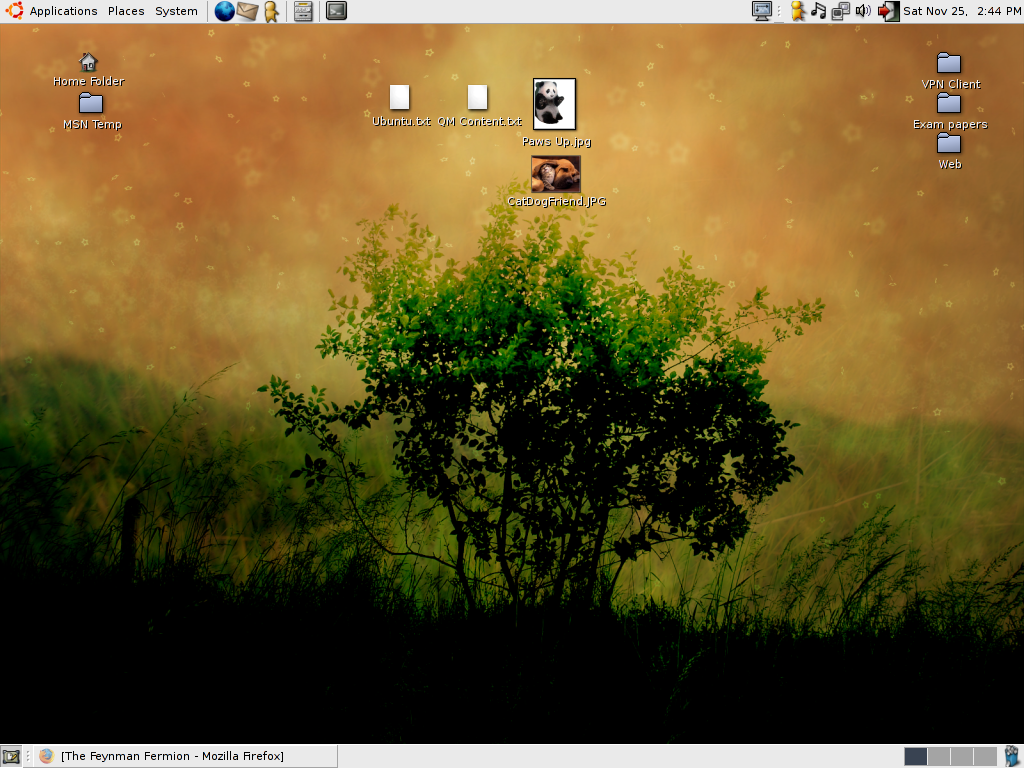
ubuntu desktop

One of the major hurdles one finds when attempting to install Linux on his/her computer is the installation itself. Not only do you need to partition your hard disk if you have not done so (unless you have a physically second hard disk), you also need to know your computer specifications (like what ethernet card it is using). And some Linux distribution installers are not able to recognise SATA hard disks which most laptops (including mine - IBM Thinkpad T43) use. This is the case when I tried to install the powerful Debian which all SPS computer uses.

Fortunately, Ubuntu cuts out most of that job. Okay, partitioning of hard disk still remains but that's not really a screwy job as it may sound, though it may be daunting if it's your first time tweaking with the foundations of your computer. I recommend using the Disk Management in Windows to partition the hard drive itself; it is easy to use, comes along with Windows XP, and since it is running on that partition itself, there's little risk of destroying your Windows partition. (Note that two partitions are needed, a "\root" where the Linux will run and a small "\temp" with the memory size same as your RAM.) Apart from partitioning, Ubuntu's graphical installer really makes it friendlier than other distributions' text based installer.

The default interface is Gnome, one of the most popular interfaces for Linux (if you want KDE, go for Kubuntu). Slick and clean and not too different from the Windows interface, the only dissatisfaction I have with it is the huge icon sizes. As compared to Windows, these Linux interfaces' greatest advantage is the multiple desktops, which is most wonderful (but not limited to) situations when you're running programs that uses a copious amount of windows (like Adobe Photoshop or its open-source equivalent, The GIMP; I was tempted to say Internet Explorer for its poor popup blocking abilities, but since IE7 is out, I shall forgive it).

Most programs in Windows have an equivalent in Linux. OpenOffice.org is Linux's equivalent of Microsoft Office (OpenOffice.org is also available in Windows, for those who are too poor to own an original copy or too lofty to have a pirated one). There's of course Firefox in Linux that's equivalent to , well, Firefox in Windows! Thunderbird also works in Linux, or you can also have Evolution Mail which comes pre-installed in Gnome. Ubuntu also has music/video/CD players, as well as instant messaging client Gaim, or if you want an MSN clone, aMSN.

For programs like Thunderbird and aMSN that don't come installed, all you need is a working Internet connection. Then, under the Applications menu (the Start menu equivalent of Windows), choose "Add/Remove...". It works something like the "Add/Remove Programs" in Windows' Control Panel, but unlike the latter which only searches for programs installed in your computer, it goes onto the Internet and search for lists of programs available (from the Ubuntu repositories, which can be modified if you wish). Installing and uninstalling involves just a few clicks. However, installing programs that are not on the repositories can be a headache; fortunately, that situation seldom surfaces.

The best thing about these programs, other than, to a computer programmer, being open source, is that it is free! No more having to fork out hundreds of dollars for programs; no more having to resort to piracy! Of course, that alone means that many Windows-only program like ABAQUS and AutoCAD are not available, which is why I recommend keeping your Windows system alongside with Linux (i.e. dual boot). Alternatively, you can use Wine, a Windows emulator that runs well for quite a handful of Windows-only programs. In fact, according to Wine's official database, games like Diablo 2, Counter-Strike, Warcraft III and World of Warcraft works pretty satisfactorily. But if it is your work computer you should not even have such abominations in it in the first place...

Another advantage I find in Linux is that it takes much shorter for the system to start up. For my laptop to boot Windows completely, I gotta wait for about half a minute before the login dialog drags itself onto screen, then another two or three minutes for Windows to stop spinning my hard disk. For Ubuntu, it takes less than half a minute for the login dialog box to appear, and less than ten seconds after logging in for the system to be ready. Talking about speed!

Other minor plus points about Linux is that it naturally comes with a C compiler (GNU Compiler Collection, or "gcc"), as anyone with formal education in C programming would know (however, it doesn't come pre-installed in Ubuntu, though a "apt-get install build-essential" in the Terminal will resolve that. Gnome also has an amazing amount of screensavers. Also, you can fetch files from any account in your Windows system (which goes to show the security, or lack thereof, of Windows systems).

Personally, I strongly urge one to try out Ubuntu. If anything, take it as an exploration into the various dimensions of computers. For once, don't be a bluepill. Live no longer in the Blue Screen of Death. Free your (computer's) mind.