Showing posts with label social. Show all posts
09 August 2010
How many people outside Singapore has heard of the Youth Olympic Games?
This is the result of a quick and utterly unscientific poll of the people around me, both from my hall and my lab group, here in Canberra. Certainly, it does not represent "people outside Singapore". In fact, it is hardly a fair picture of the awareness of the Youth Olympic Games (YOG) amongst the people living in Canberra since I'm sampling a mix of academically-inclined, highly-educated community with a good mix of international students. Nonetheless it should still give a hazy sketch on how many people outside Singapore knows about the YOG.
The reason why I did this poll comes from the general sentiments I've been reading about the YOG, especially on the enthusiasm (or lack thereof) of Singaporeans for the event.
The fact that Singaporeans are disinterested does not mean that the event will be a failure. What also matters is the enthusiasm of sporting fans and the international community. That, together with the apparent failure to excite Singaporeans, will be a fair measure of the success of the YOG.
So far I have not heard of the opinions of people outside Singapore on the YOG itself. I have come across no polls about their awareness of the event, and news reports about it are scant to begin with. Hence, I did this poll to throw a bit of light on this question.
More on the results: I've polled a total of 17 people. 11 (red) of them have never heard of the YOG. 2 (yellow) of them heard about it, but do not know that it is coming up or that it is held in Singapore. 4 (green) of them could answer where and when, though it must be pointed out that, of these four, one is a Singaporean and the other have been staying in Singapore for the past two years.
And of the six who know about YOG, only one of them is an Australian (the other five are Asians of varying nationalities). The reason why he knows about it is because he is a sporting enthusiast and is acquainted with news about the Australian Youth Olympic Festival, which I believe is what the YOG is based on.
I am more than aware that the sample size is way too small. However, I am not going out of the way to find out about the opinions of more people. Maybe some other people can do the same thing amongst their friends and we will have a better survey.
It is kinda hard to comment on whether the results are good or bad. We need an equivalent to compare, and I do not know enough about sporting games to do that. Perhaps 35% of awareness is okay for this type of international youth games. But my guess is that it ought to be higher.
Oh, by the way, happy 45th birthday, Singapore!
30 July 2009
The Paradox of Thio Li-Ann's Anti-Gay Stand
(Disclaimer: this post is not a writeup arguing for gay rights. Neither is this an opinion concerning Thio's withdrawal. It won't even be a rebuttal of her arguments. Any attempt at these is merely a repetition of what many others have written. Also, what is argued below is my own guesswork, and anyone with a better idea are welcomed to correct me.)
One of the recent news that has been hitting the headlines online is Thio Li-Ann's withdrawal from New York University as a visiting professor due to two reasons: low enrolment for her class and a hostile environment, both of which probably stemmed from her public anti-gay stand. Her arguments against gay rights were often ridiculed by many netizens for their gaps in logic. In fact, her parliament speech regarding the repealing of section 377A were so flawed that even the conservative Straits Times, often accused of filtering forum letters in favour of opponents of gay rights, has an editorial which lambasted her (here is an article commenting on this).
Yet, she held on to them and insisted on her opposition to gay rights. I find this situation rather curious, because she, being a professor of law, ought to either have an excellent argument for her case, or see that she is wrong. This paradox has baffled me for quite some time, but I think I've figured out why she stuck to her weak arguments: it is a consequence of trying to argue in Singapore's secular setting but retaining her stand that comes from her personal belief (and interestingly, she has attacked Singapore's secularism recently with a straw-man argument).
I remember reading an editorial at the start of this year in either Science or Nature (can't remember which) - considered by many as the top two journals in science - in which the author argues that the Obama should appoint scientists in his administration because they are trained to make "correct" judgements. His point is that a proper science training should teach the scientist not to favour, assume or even expect a particular conclusion before the experiment. A scientist, in positions of power, will therefore analyse the situation objectively based on all avaliable data and make a stand based on his analysis. This will ensure that the decision made is the best possible for the country. He contrasts this with lawyers, which are trained to pick up a particular stand and construct arguments to support it. This is, of course, rather an unfair opinion against lawyers because there is a difference between one's derivation of his stand and one's academic training, but his underlying assumption about decision-making is clear: in choosing a stand, we should analyse the arguments before making a conclusion.
There is also the joke that puts economists in the same bad shoes. It goes like this: a mathematician, a statistician and an economist were at a job interview. They were asked what two plus two is. The mathematician says, "four", and the statistician says, "on average, four". The economist, on the other hand, surreptitiously asks the interviewer, "well, what do you want it to be?" The punchline is about the wrong way of making a stand: choose the conclusion you want, before finding arguments to prop it up (and ignoring evidence that contradict that stand).
So are the arguments of the opponents to gay rights formed as such? Assembled top-down from the conclusion instead of constructed bottom-up from basic principles and evidence? Are these people like the accused lawyer in the editorial or the economist in the joke? Not necessary: they may have a different premise. Gay right proponents may have the premise that there ought to be no discrimination based on sexuality. But opponents to gay rights, such as those who have been in the spotlight recently like Thio, may have the premise that goes: "the Bible is right". If we start from this premise, it is naturally a conclusion that being gay is wrong.
Now, all this is fine and good if one applies that conclusion to oneself, but the problem comes when one tries to apply the conclusion to others, on a society-wide setting. There will inevitably be contradictions which springs from differences in premises. So in a country like Singapore we practise secularism - meaning all arguments that are forwarded in society must either be independent of system of belief or applies to all systems of belief. As a result their arguments will no longer work, because not everyone can accept the premise that "the Bible is right". Consequently, these opponents try to find an argument that is founded upon secular premises to support their stands so they can push their ideas upon the society.
But that is precisely what the economist did.
One of the recent news that has been hitting the headlines online is Thio Li-Ann's withdrawal from New York University as a visiting professor due to two reasons: low enrolment for her class and a hostile environment, both of which probably stemmed from her public anti-gay stand. Her arguments against gay rights were often ridiculed by many netizens for their gaps in logic. In fact, her parliament speech regarding the repealing of section 377A were so flawed that even the conservative Straits Times, often accused of filtering forum letters in favour of opponents of gay rights, has an editorial which lambasted her (here is an article commenting on this).
Yet, she held on to them and insisted on her opposition to gay rights. I find this situation rather curious, because she, being a professor of law, ought to either have an excellent argument for her case, or see that she is wrong. This paradox has baffled me for quite some time, but I think I've figured out why she stuck to her weak arguments: it is a consequence of trying to argue in Singapore's secular setting but retaining her stand that comes from her personal belief (and interestingly, she has attacked Singapore's secularism recently with a straw-man argument).
I remember reading an editorial at the start of this year in either Science or Nature (can't remember which) - considered by many as the top two journals in science - in which the author argues that the Obama should appoint scientists in his administration because they are trained to make "correct" judgements. His point is that a proper science training should teach the scientist not to favour, assume or even expect a particular conclusion before the experiment. A scientist, in positions of power, will therefore analyse the situation objectively based on all avaliable data and make a stand based on his analysis. This will ensure that the decision made is the best possible for the country. He contrasts this with lawyers, which are trained to pick up a particular stand and construct arguments to support it. This is, of course, rather an unfair opinion against lawyers because there is a difference between one's derivation of his stand and one's academic training, but his underlying assumption about decision-making is clear: in choosing a stand, we should analyse the arguments before making a conclusion.
There is also the joke that puts economists in the same bad shoes. It goes like this: a mathematician, a statistician and an economist were at a job interview. They were asked what two plus two is. The mathematician says, "four", and the statistician says, "on average, four". The economist, on the other hand, surreptitiously asks the interviewer, "well, what do you want it to be?" The punchline is about the wrong way of making a stand: choose the conclusion you want, before finding arguments to prop it up (and ignoring evidence that contradict that stand).
So are the arguments of the opponents to gay rights formed as such? Assembled top-down from the conclusion instead of constructed bottom-up from basic principles and evidence? Are these people like the accused lawyer in the editorial or the economist in the joke? Not necessary: they may have a different premise. Gay right proponents may have the premise that there ought to be no discrimination based on sexuality. But opponents to gay rights, such as those who have been in the spotlight recently like Thio, may have the premise that goes: "the Bible is right". If we start from this premise, it is naturally a conclusion that being gay is wrong.
Now, all this is fine and good if one applies that conclusion to oneself, but the problem comes when one tries to apply the conclusion to others, on a society-wide setting. There will inevitably be contradictions which springs from differences in premises. So in a country like Singapore we practise secularism - meaning all arguments that are forwarded in society must either be independent of system of belief or applies to all systems of belief. As a result their arguments will no longer work, because not everyone can accept the premise that "the Bible is right". Consequently, these opponents try to find an argument that is founded upon secular premises to support their stands so they can push their ideas upon the society.
But that is precisely what the economist did.
02 May 2009
The Aftermath of the AWARE War
As with all wars, there is celebration on the side of the victors, and bitterness on the side of the defeated. But as these emotions fade, what will emerge is the vast destruction done to the people and the infrastructure. Lives lost, buildings bombed, resources wasted... a scene of ruin that greets both sides.
In a similar sense, a war has broken out in Singapore's civil society, a struggle for power for one of Singapore's most prominent interest group. The dispute in AWARE has culminated in the EGM, which dragged overtime for several hours, and eventually tilted against the favour of the new AWARE committee, triggering their resignation.
But what has been destroyed in this AWARE war? One thing for sure, Constance Singam has identified that the trust that was implicit in the organisation is gone now. Like a shattered vase, there is no way to restore its original state; even with masterful reparations, cracks will forever be there.
But I think it goes beyond that. The trust amongst different interest groups in society may be under strain. And I am not talking about groups that sit on opposite sides of an issue, like evolutionists and creationists. After all, AWARE does not fight for gay-rights, yet it was on this issue that triggered the entire affair. This has shown that even if a group is only tangentially concerned with a minor issue, it is liable to be taken over by other groups. So the lesson that other groups, observing this AWARE war, can learn is to guard themselves against such a takeover by any other groups with an alternative motive. And with that, the trust is gone. And maybe... maybe, it's not so bad a thing after all.
But what will this mean, beyond all that trust and everything? Is society more polarised between pro-gays and anti-gays now? Will the battle for gay rights be more difficult now? Is it really a victory for supporters of the so-called Old Guards, especially when there were signs of rowdiness and rude interruptions? The words, the insults and the name-calling... how much of this whole saga can we call it a step forward for democracy?
Is this war really over? Or will it lead, just like World War I, to another more devastating showdown?
In a similar sense, a war has broken out in Singapore's civil society, a struggle for power for one of Singapore's most prominent interest group. The dispute in AWARE has culminated in the EGM, which dragged overtime for several hours, and eventually tilted against the favour of the new AWARE committee, triggering their resignation.
But what has been destroyed in this AWARE war? One thing for sure, Constance Singam has identified that the trust that was implicit in the organisation is gone now. Like a shattered vase, there is no way to restore its original state; even with masterful reparations, cracks will forever be there.
But I think it goes beyond that. The trust amongst different interest groups in society may be under strain. And I am not talking about groups that sit on opposite sides of an issue, like evolutionists and creationists. After all, AWARE does not fight for gay-rights, yet it was on this issue that triggered the entire affair. This has shown that even if a group is only tangentially concerned with a minor issue, it is liable to be taken over by other groups. So the lesson that other groups, observing this AWARE war, can learn is to guard themselves against such a takeover by any other groups with an alternative motive. And with that, the trust is gone. And maybe... maybe, it's not so bad a thing after all.
But what will this mean, beyond all that trust and everything? Is society more polarised between pro-gays and anti-gays now? Will the battle for gay rights be more difficult now? Is it really a victory for supporters of the so-called Old Guards, especially when there were signs of rowdiness and rude interruptions? The words, the insults and the name-calling... how much of this whole saga can we call it a step forward for democracy?
Is this war really over? Or will it lead, just like World War I, to another more devastating showdown?
25 April 2009
The Problem with the New AWARE EXCO
Undoubtedly, you would've heard of the whole nasty business that is going on in AWARE right now.
Personally, my take is this: the initial silence and lack of communications to the public, as well as the hostilities towards and dismissals of the previous EXCO members, are all worrying signs. Moreover, it is evident that there will be a change of ideals, but the new EXCO has yet to announce this agenda of theirs. Recent press conferences did shed some light on their directions, but this is only weeks after the takeover, and there were still many burning questions yet to be answered to satisfaction.
This seems to signal a "I know best, so just shut up and follow" attitude which is disturbing to say the least. Since AWARE is an activist group, communication ought to be one of the most important facet of its operations. Even as I grant the new EXCO a chance to prove and establish themselves, they have been utterly disappointing thus far.
Many of the new EXCO members have expressed concern with AWARE's pro-gay stance, which is of course valid. But AWARE is not about gay rights; it's about female rights. These people - as well as the supposed coordinator of the takeover, Thio Su Mien - were outspoken against gay rights with their frequent letters to the press, but they have done nothing similar for female rights, as far as I know.
AWARE has done much for feminine rights in Singapore. I hope the upcoming EGM will clear up certain hazy issues and allow us to, at the very least, know more about the new EXCO's plan for this organisation.
By the way, if you too find the new EXCO's actions questionable, here are two links to a website that seeks answers from them and a petition that you can lend your support to:
http://www.we-are-aware.sg/
http://www.gopetition.com/petitions/gender-equality-for-all.html
Personally, my take is this: the initial silence and lack of communications to the public, as well as the hostilities towards and dismissals of the previous EXCO members, are all worrying signs. Moreover, it is evident that there will be a change of ideals, but the new EXCO has yet to announce this agenda of theirs. Recent press conferences did shed some light on their directions, but this is only weeks after the takeover, and there were still many burning questions yet to be answered to satisfaction.
This seems to signal a "I know best, so just shut up and follow" attitude which is disturbing to say the least. Since AWARE is an activist group, communication ought to be one of the most important facet of its operations. Even as I grant the new EXCO a chance to prove and establish themselves, they have been utterly disappointing thus far.
Many of the new EXCO members have expressed concern with AWARE's pro-gay stance, which is of course valid. But AWARE is not about gay rights; it's about female rights. These people - as well as the supposed coordinator of the takeover, Thio Su Mien - were outspoken against gay rights with their frequent letters to the press, but they have done nothing similar for female rights, as far as I know.
AWARE has done much for feminine rights in Singapore. I hope the upcoming EGM will clear up certain hazy issues and allow us to, at the very least, know more about the new EXCO's plan for this organisation.
By the way, if you too find the new EXCO's actions questionable, here are two links to a website that seeks answers from them and a petition that you can lend your support to:
http://www.we-are-aware.sg/
http://www.gopetition.com/petitions/gender-equality-for-all.html
09 June 2008
A Case of Similar Attractions
On today's Straits Times (via SingaporeSurf), there was an article on the tourist attractions in Singapore being too expensive for most Singaporeans (digression: sounds like a contradiction to me, but that's just my phrasing; the holy Straits Times will never make such a lousy mistake). Well, well... it just sounds like those other articles that cling onto my brain with the same lifetime as an excited atom, until I hit upon this quote,
Okay I know too little about attractions in the US, and yes, relatively is a relatively ambiguous term. But compared to similar attractions in Australia? I'm not so sure. Of course, it does come down to how you define similar.
If we're comparing tourist-traps of both locations, like WhiteWater World and Warner Bro. Movie World in Gold Coast, yeah then perhaps that sentence makes sense, for an entry ticket into these places can cost up to hundreds per person and few hundreds a family. Singapore's, on the other hand, "would set a family of four back by $125 on average."
However, if we compare the same kind of attractions, like zoo to zoo, then I think it may not be quite on the mark. I remember going to the Melbourne Zoo (up to the gate, but not into it) and the entrance fee was like only A$20+ per person. Night Safari? You can always walk into the wilderness for free and get friendly with the kangeroos... or if you wish for a safe journey of higher yield, the Bonorong Wildlife Park I visited in Tasmania allows entry at about A$15+ per person. And many attractions like nature reserves and parks are free. The same goes for the annual Floriade festival in Canberra.
This reminds me of a discussion with Yao while walking through Floriade. Surely, the state government has to put in few hundreds of thousands of dollars at least in the creation and maintenance of this festival. Could Singapore do the same, with that grand scale and stunning variety? Our conclusion: maybe, but how much will the entrance fee be?
So I do think that the statement by that spokesman may not be quite right, depending on how it's interpreted. Of course, there's the second part on the value of the experience, and I think the judgement is best given by the individual.
Ms Isabel Cheng, a spokesman for the Singapore Zoo, Jurong BirdPark and Night Safari, said that admission rates are 'relatively low' compared to similar attractions in Australia and the United States, and that the experience one gets is worth the money.
Okay I know too little about attractions in the US, and yes, relatively is a relatively ambiguous term. But compared to similar attractions in Australia? I'm not so sure. Of course, it does come down to how you define similar.
If we're comparing tourist-traps of both locations, like WhiteWater World and Warner Bro. Movie World in Gold Coast, yeah then perhaps that sentence makes sense, for an entry ticket into these places can cost up to hundreds per person and few hundreds a family. Singapore's, on the other hand, "would set a family of four back by $125 on average."
However, if we compare the same kind of attractions, like zoo to zoo, then I think it may not be quite on the mark. I remember going to the Melbourne Zoo (up to the gate, but not into it) and the entrance fee was like only A$20+ per person. Night Safari? You can always walk into the wilderness for free and get friendly with the kangeroos... or if you wish for a safe journey of higher yield, the Bonorong Wildlife Park I visited in Tasmania allows entry at about A$15+ per person. And many attractions like nature reserves and parks are free. The same goes for the annual Floriade festival in Canberra.
This reminds me of a discussion with Yao while walking through Floriade. Surely, the state government has to put in few hundreds of thousands of dollars at least in the creation and maintenance of this festival. Could Singapore do the same, with that grand scale and stunning variety? Our conclusion: maybe, but how much will the entrance fee be?
So I do think that the statement by that spokesman may not be quite right, depending on how it's interpreted. Of course, there's the second part on the value of the experience, and I think the judgement is best given by the individual.
22 April 2008
A Disappointing Report on Mas Selamat's Escape
After one month of tedious investigation by the Commission of Inquiry, the report on Mas Selamat's escape is finally released. No, wait. Not the full report, but just the executive summary. Okay, I think Ministry of Home Affairs got me here: when they said they "promised to give the public a full account", it is not equivalent to the complete report. How silly of me to assume so!
In any case, I've briefly glanced through the summary (yes, I'm that free despite my upcoming exams), and to be honest, I thought much of it was just telling us the obvious. It just acts as an official and substantiated confirmation of what many already knew: unsecured window, negligent guards.
The non-working CCTVs is something new, though. However, the summary does not go into details of these non-working CCTVs. For example, is it clear to any persons who see the CCTVs that they are non-functioning ones? And how widespread is this news of non-functionality? Do the guards know? Does Mas Selamat know? Non-working CCTVs are actually okay, in my opinion, so long as its lack of functioning is unknown to the "watched". The construct of the panopticon is, after all, one of the best surveillance concept ever conceived.
Another piece of information worth thinking about is the conclusion that Mas Selamat has been planning his escape and is just waiting for the right time. This is drawn from the fact that Mas Selamat emerged from the Locker Room with two sets of clothes. It is not clear to me what happened in exact, but I think the details are not of importance. What I am more concerned with is that, if Mas Selamat has planned it well, he would've informed and sought external help, and as such, it still puzzles me why the authorities firmly believe he is still in Singapore, and more so in the forests. Personally, I believe it is far likelier that he is off Singapore soil or, if not so, hiding in some obscure urban area. But then again, ISD made it sound like they have some intelligence we don't, so I suppose it is a waste of effort to speculate so much.
I know the COI was suppose to investigate on the detention centre and that only, but I was actually hoping that there were some checks into the poor coordination beyond the installation itself. Specifically, I think many people are concerned with the lack and delay of information from the police, and the immediacy (or lack thereof) of the clamp down across the borders. If the COI did not touch this, this probably means that we will never know, unless there is another inquiry, the reason why there is such poor coordination between the authorities and the public.
To be honest, I am a bit disappointed by the summary. It reveals far too little information and is not wide enough in scope. I think we can only be satisfied for now to listen to any further revelations in the parliament.
In any case, I've briefly glanced through the summary (yes, I'm that free despite my upcoming exams), and to be honest, I thought much of it was just telling us the obvious. It just acts as an official and substantiated confirmation of what many already knew: unsecured window, negligent guards.
The non-working CCTVs is something new, though. However, the summary does not go into details of these non-working CCTVs. For example, is it clear to any persons who see the CCTVs that they are non-functioning ones? And how widespread is this news of non-functionality? Do the guards know? Does Mas Selamat know? Non-working CCTVs are actually okay, in my opinion, so long as its lack of functioning is unknown to the "watched". The construct of the panopticon is, after all, one of the best surveillance concept ever conceived.
Another piece of information worth thinking about is the conclusion that Mas Selamat has been planning his escape and is just waiting for the right time. This is drawn from the fact that Mas Selamat emerged from the Locker Room with two sets of clothes. It is not clear to me what happened in exact, but I think the details are not of importance. What I am more concerned with is that, if Mas Selamat has planned it well, he would've informed and sought external help, and as such, it still puzzles me why the authorities firmly believe he is still in Singapore, and more so in the forests. Personally, I believe it is far likelier that he is off Singapore soil or, if not so, hiding in some obscure urban area. But then again, ISD made it sound like they have some intelligence we don't, so I suppose it is a waste of effort to speculate so much.
I know the COI was suppose to investigate on the detention centre and that only, but I was actually hoping that there were some checks into the poor coordination beyond the installation itself. Specifically, I think many people are concerned with the lack and delay of information from the police, and the immediacy (or lack thereof) of the clamp down across the borders. If the COI did not touch this, this probably means that we will never know, unless there is another inquiry, the reason why there is such poor coordination between the authorities and the public.
To be honest, I am a bit disappointed by the summary. It reveals far too little information and is not wide enough in scope. I think we can only be satisfied for now to listen to any further revelations in the parliament.
09 March 2008
Three Thoughts on the Mas Selamat Fiasco
With Mas Selamat, who probably has more posters of himself than the entire population of Singapore, still at large, many questions have been raised and pretty much none answered. Lots of accusations and demands of resignation has been thrown all over, but beyond these political mumbo jumbo, I observed a few aspects of this fiasco which interests me. First is the conspiracy theory that he was killed; second is the question as to whether he's still in Singapore; third being the holy grail of all questioners: how did it happen? Here are my takes:
In the lack of information, it seemed that some people has taken to speculate and believe the possibility that Mas Selamat was killed inside the detention centre and the authorities spun this story to cover it up, fearing the backlash of human rights activists and whatnots.
It hardly need to be said how absurd this is. Suppose this were true. Then a few weeks later the JI members, wondering why their ex-leader has yet to come back to them, will start making noise, and then the whole cover-up will be exposed. To avoid this, the authorities can "catch and kill Mas Selamat" some time later, but that would pose problems with regards to the autopsy and all. And of all that, wouldn't it be simpler to just announce that he has died by unnatural causes like heart attack? Or if that's medically dubious, then say that he choked on a chicken wing. Sure, there may be some questions raised, but as compared to this?
In any case, I truly believe that he has escaped. Now, is he still in Singapore? It all depends on whether it was a planned course or a spontaneous event. If it's the former, then he would be far away from Singapore by now. It doesn't take a genius to figure out that his best chance is to leave Singapore immediately before the authorities can raise the alarm, which is ASAP. If it was spontaneous, i.e. the chance just came and he fled, then he's probably still in Singapore (but of course with help) until the authorities cannot maintain the high level alert.
And the golden question of it all: how did he escape? I do not know for sure, though the supposed Independent Commission is to shed some light on this. But given official statements so far, I think one can do a Sherlock Holmes and pieces them together. We know that he escaped through a toilet. We also know that MM Lee mentioned something about complacency. We know that he's due for a family visit (i.e. the place is open to certain outside people). Now, if we assume, very reasonably, that there are two different kinds of toilet - one for outside people (and maybe the ISD people there) and one for inside people (like Mas Selamat) - and keeping in mind MM Lee's praise of winning the trust of the guards, I think the puzzle sort of comes together.
So that's my thoughts. And if anyone's wondering, I do not think that the four hours lapse is unreasonable. Oh, one more thing: I didn't receive the MMS of his face... how did the government know that I'm bad at recognising people?
In the lack of information, it seemed that some people has taken to speculate and believe the possibility that Mas Selamat was killed inside the detention centre and the authorities spun this story to cover it up, fearing the backlash of human rights activists and whatnots.
It hardly need to be said how absurd this is. Suppose this were true. Then a few weeks later the JI members, wondering why their ex-leader has yet to come back to them, will start making noise, and then the whole cover-up will be exposed. To avoid this, the authorities can "catch and kill Mas Selamat" some time later, but that would pose problems with regards to the autopsy and all. And of all that, wouldn't it be simpler to just announce that he has died by unnatural causes like heart attack? Or if that's medically dubious, then say that he choked on a chicken wing. Sure, there may be some questions raised, but as compared to this?
In any case, I truly believe that he has escaped. Now, is he still in Singapore? It all depends on whether it was a planned course or a spontaneous event. If it's the former, then he would be far away from Singapore by now. It doesn't take a genius to figure out that his best chance is to leave Singapore immediately before the authorities can raise the alarm, which is ASAP. If it was spontaneous, i.e. the chance just came and he fled, then he's probably still in Singapore (but of course with help) until the authorities cannot maintain the high level alert.
And the golden question of it all: how did he escape? I do not know for sure, though the supposed Independent Commission is to shed some light on this. But given official statements so far, I think one can do a Sherlock Holmes and pieces them together. We know that he escaped through a toilet. We also know that MM Lee mentioned something about complacency. We know that he's due for a family visit (i.e. the place is open to certain outside people). Now, if we assume, very reasonably, that there are two different kinds of toilet - one for outside people (and maybe the ISD people there) and one for inside people (like Mas Selamat) - and keeping in mind MM Lee's praise of winning the trust of the guards, I think the puzzle sort of comes together.
So that's my thoughts. And if anyone's wondering, I do not think that the four hours lapse is unreasonable. Oh, one more thing: I didn't receive the MMS of his face... how did the government know that I'm bad at recognising people?
20 January 2008
How Wrong is the Principal?
Following a Straits Times report of a principal dealing harsh words to a group of secondary 5 students, both the online and offline worlds have exploded in a furious mash of voices condemning the acts of the principal and dishing out voices of support and sympathy to the students. There were very few voices to the contrary, and even these are defending the general case and not the principal in specific. To me, it appears as if most people have jumped into conclusions, for I can yet determine if the principal spoke out of self-interest or did she, as the Minister of State for Education explained, meant well as she was giving the students a wake-up call. Certainly, she was wrong, but depending on whether she had ill intentions or not, she could be wrong in very different ways.
There are two possibilities: the principal wants a nice record for her school and herself because of it being a crucial factor to her salary and resume; there is also the possibility of the principal being truly concerned with the students, but chose very wrong words indeed. Both, of course, are wrong, but they are wrong in very different ways. There is also a common wrong in that she implied a low stature for the ITE, but I shall ignore this for the moment and consider the two possibilities.
Now, the first possibility seems to be the conclusion of most people's reasoning, for it was written in the newspapers that "she also stressed that she wanted 100 per cent passes in her school." Now, this is a very tricky sentence. First and foremost, we must note that it comes from the journalist's reporting, which may not reflect and may comprise a sensationalisation of the actual situation. Secondly, it is not clear where the source of this claim is. Was it from all the 27 students the principal spoke to? Was it from parents, who are more prone to overreacting as all parents will? Was it from one student, who may have misinterpreted the principal's words, for she could've very well said something like, "I want all of you to pass your exams" - a well-meaning sentence?
As for the second possibility of using wrong words, she might've made a poor decision in choosing to say what she said and doing what she did. Yes, it's wrong, but in my opinion - and I surmise many will agree with me - that this wrongness is not as dire as the first possibility, for after all it emerged from a true concern of the students. In fact, this can also explain the ITE comment. How likely is she to commit such a mistake? I don't know, but I know it is easy to make a comment (especially to a large crowd) and have it misinterpreted, having it happen to me numerous times.
I'm definitely not supporting the principal, but I'm not faulting her either. At least not yet. In my opinion, there is still a lot unknown to us. All these while, we have not heard the principal defend herself (other than in the initial report), for example. Therefore, for now, my conclusion is that there exists the possibility (and significant probability) that the principal is well-meaning but employed flawed words. It could be otherwise, of course, but how do we know?
There are two possibilities: the principal wants a nice record for her school and herself because of it being a crucial factor to her salary and resume; there is also the possibility of the principal being truly concerned with the students, but chose very wrong words indeed. Both, of course, are wrong, but they are wrong in very different ways. There is also a common wrong in that she implied a low stature for the ITE, but I shall ignore this for the moment and consider the two possibilities.
Now, the first possibility seems to be the conclusion of most people's reasoning, for it was written in the newspapers that "she also stressed that she wanted 100 per cent passes in her school." Now, this is a very tricky sentence. First and foremost, we must note that it comes from the journalist's reporting, which may not reflect and may comprise a sensationalisation of the actual situation. Secondly, it is not clear where the source of this claim is. Was it from all the 27 students the principal spoke to? Was it from parents, who are more prone to overreacting as all parents will? Was it from one student, who may have misinterpreted the principal's words, for she could've very well said something like, "I want all of you to pass your exams" - a well-meaning sentence?
As for the second possibility of using wrong words, she might've made a poor decision in choosing to say what she said and doing what she did. Yes, it's wrong, but in my opinion - and I surmise many will agree with me - that this wrongness is not as dire as the first possibility, for after all it emerged from a true concern of the students. In fact, this can also explain the ITE comment. How likely is she to commit such a mistake? I don't know, but I know it is easy to make a comment (especially to a large crowd) and have it misinterpreted, having it happen to me numerous times.
I'm definitely not supporting the principal, but I'm not faulting her either. At least not yet. In my opinion, there is still a lot unknown to us. All these while, we have not heard the principal defend herself (other than in the initial report), for example. Therefore, for now, my conclusion is that there exists the possibility (and significant probability) that the principal is well-meaning but employed flawed words. It could be otherwise, of course, but how do we know?
14 July 2007
The Government's Forced Prostitute
(This post evolved out of my comments on a post entitled Silence is not always golden on theonlinecitizen. The post criticises the lack of scrutiny by Singapore's mainstream media on the government.)
In recent weeks, a chain of non-replies from the government concerning many issues, the termination of Alfian Saat as a relief teacher for example, has infruriated many bloggers. Even moderate bloggers like Bernard Leong advocated for more openness in the government's reply and letters to the media. And as inevitable as the Second Law, the mainstream media gets a beating for not scrutinising the government over these matters and not pursuing the non-replies.
With regards to the non-replies and silences of various government departments regarding numerous affairs, I believe it is something on which the government has to seriously change its attitude. Such attitudes, more than just make people lose faith in the government and the civil service, can propel others to believe in alternative (and not necessarily true) explanations. This may be dangerous as it propagates falsehoods on the government and undermine the trust between the civil service and the people. And with no official explanations, they can hardly be blamed.
However, I do not agree with criticising the media for not playing the role of the watchdog like in so many democratic countries. I do not deny - in fact, I strongly support - the concept of the media being the watchdog of the government. Being a proper, massive organisation with professional journalists to probe and analyse various aspects on and reports of the government and its actions, hardly any other is better at fulfilling this role. However, at this point I'd like to emphasize the need, if thus is the case, for more media organisations to emerge. Left to its own, a media organisation will inevitably adopt a particular stand or point of view, so a greater number means a greater variety, leading to a more balanced airing of different perspective on a single issue. It is as pointless as the current situation if the media turns from the government's lap dog to a mad dog which bites at everything the government has.
However, I can hardly fault the media for taking up the role it took. The rules and regulations governing the media - the Newspaper and Printing Act - effectively gives the government the control of information. The media, in my opinion, can only take a small portion of the blame, if at all. After all, which media would like to see its readership fall? Which journalist would like to work under a heavily scrutinised and censored environment? Blaming the media is like shooting the hapless messenger. Of course, there are always those who are truly sincere in their flattering of the government, but we must caution ourselves against a hasty generalisation just as much as believing everything the media prints.
Of course, one could argue that the journalists ought to sacrifice themselves for their journalistic pride and freedom of expression. Yet, if these employees of the media can be kicked aside and replaced so easily, can we blame them for being concerned with their jobs and income? After all, if they are unwilling to write favourable or refrain from criticising the government, someone else would be willing to do the job, and the situation on the whole remains the same. Or, can we blame them for bowing down now, so that they can stay longer to push the boundaries of these regulations as far as they could go? Let's not forget that, these people are in the public, their faces known, unlikes the criticising mass of the netizens who are largely anonymous, and whose job is not directly affected by what he or she writes.
Instead of shifting the blame onto the media, I would instead focus my criticisms on these regulations that bind the muzzle of the watchdog. The media is not, as David Marshall once famously said, "poor prostitutes" of the government. If anything, the media is a forced prostitute of the government.
In recent weeks, a chain of non-replies from the government concerning many issues, the termination of Alfian Saat as a relief teacher for example, has infruriated many bloggers. Even moderate bloggers like Bernard Leong advocated for more openness in the government's reply and letters to the media. And as inevitable as the Second Law, the mainstream media gets a beating for not scrutinising the government over these matters and not pursuing the non-replies.
With regards to the non-replies and silences of various government departments regarding numerous affairs, I believe it is something on which the government has to seriously change its attitude. Such attitudes, more than just make people lose faith in the government and the civil service, can propel others to believe in alternative (and not necessarily true) explanations. This may be dangerous as it propagates falsehoods on the government and undermine the trust between the civil service and the people. And with no official explanations, they can hardly be blamed.
However, I do not agree with criticising the media for not playing the role of the watchdog like in so many democratic countries. I do not deny - in fact, I strongly support - the concept of the media being the watchdog of the government. Being a proper, massive organisation with professional journalists to probe and analyse various aspects on and reports of the government and its actions, hardly any other is better at fulfilling this role. However, at this point I'd like to emphasize the need, if thus is the case, for more media organisations to emerge. Left to its own, a media organisation will inevitably adopt a particular stand or point of view, so a greater number means a greater variety, leading to a more balanced airing of different perspective on a single issue. It is as pointless as the current situation if the media turns from the government's lap dog to a mad dog which bites at everything the government has.
However, I can hardly fault the media for taking up the role it took. The rules and regulations governing the media - the Newspaper and Printing Act - effectively gives the government the control of information. The media, in my opinion, can only take a small portion of the blame, if at all. After all, which media would like to see its readership fall? Which journalist would like to work under a heavily scrutinised and censored environment? Blaming the media is like shooting the hapless messenger. Of course, there are always those who are truly sincere in their flattering of the government, but we must caution ourselves against a hasty generalisation just as much as believing everything the media prints.
Of course, one could argue that the journalists ought to sacrifice themselves for their journalistic pride and freedom of expression. Yet, if these employees of the media can be kicked aside and replaced so easily, can we blame them for being concerned with their jobs and income? After all, if they are unwilling to write favourable or refrain from criticising the government, someone else would be willing to do the job, and the situation on the whole remains the same. Or, can we blame them for bowing down now, so that they can stay longer to push the boundaries of these regulations as far as they could go? Let's not forget that, these people are in the public, their faces known, unlikes the criticising mass of the netizens who are largely anonymous, and whose job is not directly affected by what he or she writes.
Instead of shifting the blame onto the media, I would instead focus my criticisms on these regulations that bind the muzzle of the watchdog. The media is not, as David Marshall once famously said, "poor prostitutes" of the government. If anything, the media is a forced prostitute of the government.
24 February 2007
A Zeroth World Singapore
Splashed over headlines of today's newspapers is a story about Minister Mentor Lee Kuan Yew's speech at the Tanjong Pagar Chinese New Year dinner, envisioning Singapore in "the upper half of the First World" in "10 to 20 years". A very bold prediction, but how likely is it to happen?
The whole article highlights, building on MM Lee's speech, the economical and infrastructural developments Singapore has achieved to move towards this direction, which I must admit is pretty impressive. There's the Esplanade to drive the arts scene in Singapore, to the residences inside the city area to diversify the character of the CBD, there is little doubt that, in these aspects, Singapore can reach the standards of New York, London or Paris - cities MM Lee cited as Singapore's goals.
But I think the greatest barrier to this dream comes not in the economic aspect but in the social part. Becoming New York or Paris means embracing diversity and allow nonconformities, celebrate mavericks and encouraging differences. Are we ready to let go of our "conservativeness", the oft cited reason for the presence of anti-gay sex laws? Note that it does not mean that people should not be conservative; it means that society as a whole should have space for both people with conservative thoughts as well as people with liberal ideas.
Are we ready to not look down on people who chooses a different path in life? That is, not the typical "study study study and get a degree" path, but one which sees people dropping their studies for their dreams, such as - or in fact, especially - in the performing arts, where it has been traditionally viewed as a dead end.
Are we ready to recognise people who does not have a degree? Are we ready to commend not just "degree-less" people who are successful, but also anyone else who tries to be? Are we ready to see failures as just another facet of life, something that everyone should have no qualms about making?
Are we ready to not just tolerate but welcome other religions - not just state-sanctioned ones - and beliefs? Are we ready to accept gays, lesbians and bisexuals? Are we ready not to laugh or make jokes about effeminate men or tomboyish girls? Are we ready for people kissing (heterosexual and homosexual) in the public without others getting offended and write to the newspapers to complain?
The answer to these questions, I believe, parallels that of the acceptance of revolutionary ideas in science. Max Planck has a quote which describes this very well.
Is Singapore ready? I think not in 10 or 20 years' time.
The whole article highlights, building on MM Lee's speech, the economical and infrastructural developments Singapore has achieved to move towards this direction, which I must admit is pretty impressive. There's the Esplanade to drive the arts scene in Singapore, to the residences inside the city area to diversify the character of the CBD, there is little doubt that, in these aspects, Singapore can reach the standards of New York, London or Paris - cities MM Lee cited as Singapore's goals.
But I think the greatest barrier to this dream comes not in the economic aspect but in the social part. Becoming New York or Paris means embracing diversity and allow nonconformities, celebrate mavericks and encouraging differences. Are we ready to let go of our "conservativeness", the oft cited reason for the presence of anti-gay sex laws? Note that it does not mean that people should not be conservative; it means that society as a whole should have space for both people with conservative thoughts as well as people with liberal ideas.
Are we ready to not look down on people who chooses a different path in life? That is, not the typical "study study study and get a degree" path, but one which sees people dropping their studies for their dreams, such as - or in fact, especially - in the performing arts, where it has been traditionally viewed as a dead end.
Are we ready to recognise people who does not have a degree? Are we ready to commend not just "degree-less" people who are successful, but also anyone else who tries to be? Are we ready to see failures as just another facet of life, something that everyone should have no qualms about making?
Are we ready to not just tolerate but welcome other religions - not just state-sanctioned ones - and beliefs? Are we ready to accept gays, lesbians and bisexuals? Are we ready not to laugh or make jokes about effeminate men or tomboyish girls? Are we ready for people kissing (heterosexual and homosexual) in the public without others getting offended and write to the newspapers to complain?
The answer to these questions, I believe, parallels that of the acceptance of revolutionary ideas in science. Max Planck has a quote which describes this very well.
"A new scientific truth does not triumph by convincing its opponents and making them see the light, but rather because its opponents eventually die, and a new generation grows up that is familiar with it." - Max Planck
Is Singapore ready? I think not in 10 or 20 years' time.
21 December 2006
Singapore's Stand on Antipersonnel Landmines
In the Nobel Exhibition, the International Campaign to Ban Landmines (ICBL), an organisation that won the 1997 Nobel Peace Prize, was featured extensively. Two sets of displays in the artefacts section as well as a short film in the Creative Milieus theatre are related to them, making them one of the most highlighted organisation in the entire exhibition.
Founded in 1992, their primary objective is to completely ban the use of antipersonnel mines in the world. Their success was phenomenal. From a coalition of a handful of NGOs, it has grown into a network of more than a thousand groups. One of the major successes was their win of the Nobel Peace Prize in 1997, but the greatest achievement of their work was the Ottawa Treaty.
However, many of the powerful countries in the world refused to sign the treaty. They include the United States, China and Russia. Many have their own reasons for not doing so (such as the US, who needs landmines to protect South Korea from North Korea). That was what I found and prepared for my duty as an exhibition guide. However, curiosity nudged me to find out more, especially with regards to Singapore's status.
It turns out that, expectedly, Singapore has not signed the Ottawa Treaty. More than that, Singapore is a producer of landmines (see this ICBL newsletter, third paragraph). This is kept a low profile in Singapore, which is not surprising since this is something not to be proud of. Even Indonesia has recently signed and ratified the treaty. As a matter of fact, most guys who have been through the army would be able to attest that there is at least basic landmine deployment training.
This led me further to ponder on the question: would Singapore ever deploy landmines? My personal opinion is no. The Singapore Army's main purpose is to defend Singapore, and its greatest strength lies in deterrence. Even if we take into consideration the unlikely possibility of Singapore entering a conflict, it is unlikely that we are on the offensive. I doubt Singapore will start planting landmines along Woodlands. However, there is the possibility of pre-emptive strikes, which Singapore occupies a foreign land to act as a buffer against foreign attacks. Would landmines be a possibility then? Probably, but then the chances of this happening is very low.
In that case, why doesn't Singapore sign and ratify the treaty, since we're probably not going to use landmines anyway? My guess is that there are two reasons. First, remember that the army's strength lie in deterrence. And the knowledge that we possess and may deploy landmines contributes to this deterrence. For all we know, we may not even use landmines in times of conflict. The situation is similar to the serial numbers on polling cards.
My second guess is that, it does not benefit Singapore to sign the treaty. Let's face it: Singapore is a pragmatic country. Our government is pragmatic. A larger part of the population is pragmatic. What would signing the treaty give Singapore? Putting it another way, what harm will it cause Singapore if it doesn't sign the treaty? In addition, with countries like the US and China not signing it, Singapore is safe from international ridicule.
Personally, I support ICBL's goals and agrees with their principles. I would be most delighted if Singapore signs and ratifies the Ottawa Treaty. But frankly, I don't expect that to happen soon. That's life. Life sucks. Get used to it.
Founded in 1992, their primary objective is to completely ban the use of antipersonnel mines in the world. Their success was phenomenal. From a coalition of a handful of NGOs, it has grown into a network of more than a thousand groups. One of the major successes was their win of the Nobel Peace Prize in 1997, but the greatest achievement of their work was the Ottawa Treaty.
However, many of the powerful countries in the world refused to sign the treaty. They include the United States, China and Russia. Many have their own reasons for not doing so (such as the US, who needs landmines to protect South Korea from North Korea). That was what I found and prepared for my duty as an exhibition guide. However, curiosity nudged me to find out more, especially with regards to Singapore's status.
It turns out that, expectedly, Singapore has not signed the Ottawa Treaty. More than that, Singapore is a producer of landmines (see this ICBL newsletter, third paragraph). This is kept a low profile in Singapore, which is not surprising since this is something not to be proud of. Even Indonesia has recently signed and ratified the treaty. As a matter of fact, most guys who have been through the army would be able to attest that there is at least basic landmine deployment training.
This led me further to ponder on the question: would Singapore ever deploy landmines? My personal opinion is no. The Singapore Army's main purpose is to defend Singapore, and its greatest strength lies in deterrence. Even if we take into consideration the unlikely possibility of Singapore entering a conflict, it is unlikely that we are on the offensive. I doubt Singapore will start planting landmines along Woodlands. However, there is the possibility of pre-emptive strikes, which Singapore occupies a foreign land to act as a buffer against foreign attacks. Would landmines be a possibility then? Probably, but then the chances of this happening is very low.
In that case, why doesn't Singapore sign and ratify the treaty, since we're probably not going to use landmines anyway? My guess is that there are two reasons. First, remember that the army's strength lie in deterrence. And the knowledge that we possess and may deploy landmines contributes to this deterrence. For all we know, we may not even use landmines in times of conflict. The situation is similar to the serial numbers on polling cards.
My second guess is that, it does not benefit Singapore to sign the treaty. Let's face it: Singapore is a pragmatic country. Our government is pragmatic. A larger part of the population is pragmatic. What would signing the treaty give Singapore? Putting it another way, what harm will it cause Singapore if it doesn't sign the treaty? In addition, with countries like the US and China not signing it, Singapore is safe from international ridicule.
Personally, I support ICBL's goals and agrees with their principles. I would be most delighted if Singapore signs and ratifies the Ottawa Treaty. But frankly, I don't expect that to happen soon. That's life. Life sucks. Get used to it.
24 November 2006
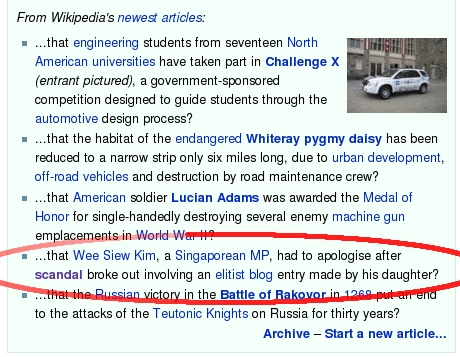
Wee Shu Min Wikipedia-ed
14 November 2006
GST: Reshuffling the Cards of Wealth?
Okay, the bomb is out, and the blogosphere is, expectedly, buzzing like a disturbed hive. The primary reason outlined for the hike is
That sounds great, huh? Why then is the blogosphere so angry? Is it an instinctive response to blast any penalising policies of the hegemonic government, or are they seeing something I cannot? Seriously, if we raise taxes to help the poor and bridge the rich-poor divide which is dangerously becoming a threatening social issue, what's wrong with that?
Unless you're in financial difficulties, the rise in GST won't pose much problems for you. Certainly with my stingy lifestyle, it will be the least of my worries. Of course, the poor still has to buy stuff and hence the increase will affect them, but as mentioned, there are social nets that'll help them overcome this barrier. Furthermore, it is usually the more affluent that makes more purchases, so they will be the one who pay more. And if this money they pay gets channeled back to the poor, then isn't that a good idea?
Of course, there are better ways to fund this purpose, specifically a rise in income tax instead of GST. However, income tax hikes will pinch the richer citizens much harder than a rise in GST, and since most (if not all) of the MPs and ministers earn five digit salaries every month, they naturally won't support such a motion. (This assumes that our MPs and ministers are selfish, which I see no reason why not to, given our fanatically meritocratic and elitist system. It's no use challenging this assumption; it is a fact of reality.) So that leaves GST as the second best option available (enlighten me, anyone, of better plans that I've missed).
That is not to say I support the hike, however, at least not yet. The principle of the hike is good, but I must wait for the details first before deciding if I really agree with the hike. It is no use if the "safety nets" mentioned is just an appeasing farce, an empty gesture. It is redundant if these nets have holes big enough for the likes of Tan Jee Suan to fall through. In another words, my official stand is: I'm neutral with the hike; I need to see the details before making my decision.
to finance the enhanced social safety nets, needed to help the lower income group
That sounds great, huh? Why then is the blogosphere so angry? Is it an instinctive response to blast any penalising policies of the hegemonic government, or are they seeing something I cannot? Seriously, if we raise taxes to help the poor and bridge the rich-poor divide which is dangerously becoming a threatening social issue, what's wrong with that?
Unless you're in financial difficulties, the rise in GST won't pose much problems for you. Certainly with my stingy lifestyle, it will be the least of my worries. Of course, the poor still has to buy stuff and hence the increase will affect them, but as mentioned, there are social nets that'll help them overcome this barrier. Furthermore, it is usually the more affluent that makes more purchases, so they will be the one who pay more. And if this money they pay gets channeled back to the poor, then isn't that a good idea?
Of course, there are better ways to fund this purpose, specifically a rise in income tax instead of GST. However, income tax hikes will pinch the richer citizens much harder than a rise in GST, and since most (if not all) of the MPs and ministers earn five digit salaries every month, they naturally won't support such a motion. (This assumes that our MPs and ministers are selfish, which I see no reason why not to, given our fanatically meritocratic and elitist system. It's no use challenging this assumption; it is a fact of reality.) So that leaves GST as the second best option available (enlighten me, anyone, of better plans that I've missed).
That is not to say I support the hike, however, at least not yet. The principle of the hike is good, but I must wait for the details first before deciding if I really agree with the hike. It is no use if the "safety nets" mentioned is just an appeasing farce, an empty gesture. It is redundant if these nets have holes big enough for the likes of Tan Jee Suan to fall through. In another words, my official stand is: I'm neutral with the hike; I need to see the details before making my decision.
Subscribe to:
Posts (Atom)